Ramadan and Christmas,
side by side.
I come from a family where faith was never a wall. Growing up in Albania, I watched Christian relatives sit at the iftar table during Ramadan — not because they had to, but because that is what you do when someone you love is fasting. And I watched Muslim family members join Christmas dinner without anyone thinking twice about it. This is not a rare story in Albania. It is, for many of us, simply how we grew up.
What makes Albania different.
Albania has four main religious communities — Muslim, Orthodox Christian, Catholic, and Bektashi — that have coexisted peacefully for centuries. This is not an accident of geography or politics. It is a cultural value that Albanian society has consciously preserved, even through periods of history that tested it severely.
What makes the Albanian model distinctive is not simply tolerance — the word “tolerance” suggests putting up with something. What I have seen in Albanian families is something warmer than that. It is participation. A Christian friend prepares the iftar table for a Muslim colleague who is keeping the fast. A Muslim family joins the Christmas celebration at a relative’s house. People do not attend each other’s religious moments as observers. They attend as family.
In my own family, faith was always present — but it was never exclusive. I have sat at iftar tables hosted by Christian relatives who kept none of the fast themselves but understood exactly what the moment meant to those who did. I have watched Muslim family members at Christmas dinners, fully present, not as guests of another religion but as family sharing a meal.
This is, I think, the real Albanian contribution to the world — not just that we tolerate each other, but that we have genuinely learned to celebrate each other. There is a difference, and Albania lives that difference every day.
Three scenes that explain Albanian religious life.
More than any statistic or historical account, three everyday scenes from Albanian life describe what religious harmony here actually looks like.
A Muslim man is keeping the Ramadan fast. His wife is Orthodox Christian and does not fast. In the evening, she prepares the iftar meal — breaks his fast with him, sits at the table, shares the moment. Not out of obligation. Out of love and respect for something that matters to him.
Kurban Bajram is celebrated in Albania not only by Muslim families. Christian neighbours arrive to share the meal, to celebrate together. The feast belongs to everyone at the table. Nobody asks anyone to change their faith. The invitation is enough.
In many Albanian families, the husband is Muslim, the wife Orthodox, one child was baptised Catholic, the grandparents are Bektashi. They all gather for Christmas dinner. They all gather for Eid. They light candles together at Easter and break fast together at Ramadan. The table holds all of it.
“In Albania, religion is personal. The table is shared. These two things have never been in conflict here.”
— Dionis Oruçi, Sophra Restaurant, SarandëWhy this matters more than ever.
At a time when religious division is being used as a political tool in many parts of the world, Albania’s model is worth naming clearly. It is not perfect — no society is. But the basic instinct here, the one I grew up with and see every day in Sarandë, is toward inclusion rather than separation.
When a Christian friend sets the iftar table, they are not making a political statement. They are doing what family does. When a Muslim family joins Christmas dinner, they are not making a theological compromise. They are showing up for the people they love. These small acts, repeated across millions of Albanian households for generations, have built something durable — a culture of shared humanity that survives whatever else changes around it.
I believe this is one of the most valuable things Albania has to offer the world. Not as a model to be exported wholesale, but as a proof of concept — evidence that it is possible to hold your own faith sincerely while genuinely celebrating someone else’s.
What this means at Sophra.
When I think about what Sophra represents, I think about this same idea. Our kitchen is 100% halal — because we want Muslim guests to be able to eat here with full confidence, without having to check or ask or worry. That commitment is real and it is non-negotiable.
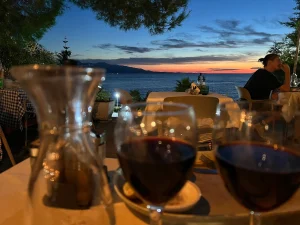
At the same time, the terrace is open to everyone. Orthodox families, Catholic tourists, secular guests, visitors from countries with no Albanian connection at all — everyone sits at the same tables, eats the same food, looks at the same Ionian Sea. The halal kitchen is not a wall between guests. It is a form of respect that makes the table larger, not smaller.
All chicken, lamb, and beef at Sophra is 100% halal, sourced from Kasapi i Prizrenit. During Ramadan, we are available for iftar — contact us in advance for groups via WhatsApp.
The terrace is walk-in, the view is the same for everyone, and the food reflects both the Albanian tradition and the Albanian spirit — which has always meant: everyone is welcome here.
Questions about Albania and faith
Is Albania a religiously tolerant country?
Yes — and more than tolerant. Albania is widely regarded as one of the most religiously harmonious countries in the world. Muslim, Orthodox Christian, Catholic and Bektashi communities have coexisted peacefully for centuries. It is common for Albanian families to include members of different faiths who celebrate each other’s religious holidays together at the same table.
Do Albanians celebrate Ramadan and Christmas together?
In many Albanian families, yes. A Christian family member setting the iftar table for Muslim relatives, or Muslim family members joining Christmas celebrations, is genuinely common in Albania — not as a symbolic gesture, but as a natural expression of family love and respect. The same family may celebrate Kurban Bajram, Eid, and Christmas in the same year.
What is Kurban Bajram in Albania?
Kurban Bajram (Eid al-Adha) is one of the most important Muslim holidays in Albania. What makes the Albanian celebration distinctive is that Christian neighbours and friends are often invited to share the feast — and usually accept. The holiday becomes a community gathering that transcends religious boundaries.
Is Sophra Restaurant halal?
Yes. All chicken, lamb, and beef at Sophra is 100% halal, sourced from Kasapi i Prizrenit. Sophra welcomes guests of all faiths and backgrounds. The halal kitchen reflects respect for Muslim guests while the table remains open to everyone.
The table is open. Always.
100% halal kitchen. Sea view terrace. Everyone welcome.
Near Mango Beach, Sarandë — open daily from 08:00.