From the sea
and the land —
why Sarandë has it all.
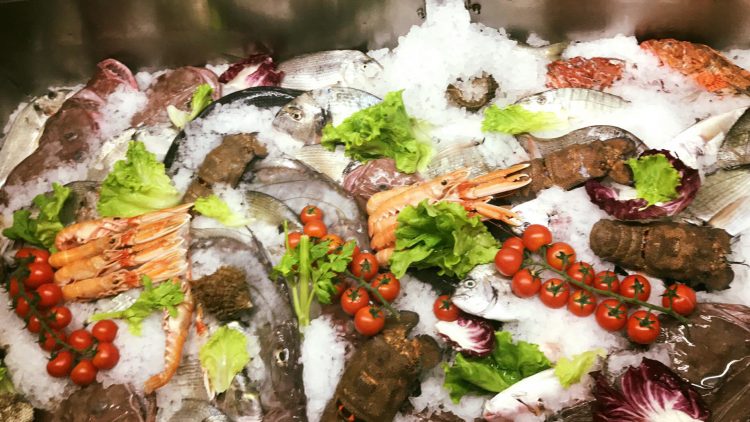
Most places in the world specialise. They are either coastal — built around fish, salt water and open flame — or they are inland, built around preserved foods, clay pots, slow cooking, and pastry. Sarandë is both. The Ionian Sea is at the door. The mountains are visible from every table. This geographical accident is the reason why the food here does not fit neatly into either category — and why a meal in this city can move between grilled seabass and slow-baked lamb in the same sitting without any contradiction.
The geography: sea at the front, mountains at the back.
Sarandë sits at the southern tip of Albania, directly across from Corfu. On a clear day — which most days are here — you can see Greece from the terrace. Behind the city, the Albanian highlands rise sharply. The distance between the sea and the mountains is small enough that both have shaped the same kitchen.
This matters for food in a practical way. Coastal cities without mountains tend to eat what the sea gives them — fish, shellfish, olive oil, lemon. Mountain communities without coast tend toward preserved foods, meat, wheat-based dishes, and slow cooking. Sarandë has never had to choose. The result is a food culture that does not look like anywhere else in the Balkans.
- Levrek — Ionian seabass, flame-grilled whole
- Koce — sea bream, light and clean
- Karkalec — shrimp, grilled over open fire
- Oktapod — octopus, slow-cooked then charred
- Midhje — mussels, from the Ionian coast
- Anchovies — marinated in lemon and olive oil
- Lamb — slow-baked in clay, the central dish
- Byrek — hand-rolled pastry from wheat dough
- Eggplant, peppers, tomatoes — baked in clay pots
- White cheese — used in byrek, starters, breakfast
- Cornbread — thick, wood-oven baked, served warm
- Yogurt — central to Tavë Kosi and Xaxiq
The Ionian side: what makes this seafood different.
The Ionian Sea around Sarandë is one of the cleaner stretches of Mediterranean water. It is deeper and colder than the Adriatic to the north, which affects the fish — the seabass and sea bream caught here tend to be firmer and more flavourful than those from warmer, shallower waters.
At Sophra, the fish and seafood we serve — seabass, sea bream, octopus, shrimp, mussels, and salmon — come through our supplier. We do not claim daily market catches because that would not always be accurate. What we can say is that the Ionian species on our menu are prepared simply: grilled over open flame, with olive oil and lemon, which is both the traditional approach and the correct one for fish of this quality.
We do not do heavy sauces on fish. Ionian seabass (levrek) and sea bream (koce) are grilled whole over open flame — the preparation is olive oil, lemon, and herbs. The Seafood Grill Mix for 2 follows the same logic: octopus, calamari, prawns and half a fish, all over open fire.
Salmon is the exception — it comes with a teriyaki glaze, which works well against the richness of the fish. The Gravlax Salmon starter is house-cured with dill and citrus.
The dishes on the sea side of the menu
Octopus, calamari, prawns, half a fish — all grilled over open flame. The clearest single statement of what Ionian seafood tastes like.
Whole Ionian seabass, flame-grilled simply. Olive oil, lemon, seasonal vegetables. The fish that defines this coastline.
Fresh-caught bream, grilled simply. Lighter than seabass, clean flavour, good with white wine.
Slow-cooked first, then charred on the grill. The outside blackens slightly; the inside stays tender. One of the most ordered dishes at Sophra.
Coastal mussels, white wine, garlic, butter. Simple and honest.
House-cured salmon with dill and citrus. We cure it here, not bought pre-cured.
The mountain side: slow cooking and the clay pot tradition.
Albanian mountain cooking is built around patience. The dishes that define it — Tavë Kosi, baked eggplant, stuffed peppers, byrek — all require time and heat that cannot be rushed. This is not a romantic idea. It is a practical reality: a clay pot that goes into the oven needs over an hour to develop the texture and flavour that makes the dish what it is.
At Sophra, the mountain side of the kitchen runs on the same logic. The oak wood-oven is lit early. The clay pots go in when the oven reaches temperature. The byrek is rolled by hand every morning. These are not marketing choices — they are simply the correct way to make these dishes.
“Tavë Kosi is lamb, yogurt, rice, and garlic — four ingredients — baked in clay for over an hour. The simplicity is the point. Every Albanian family has a version of it. No two are exactly the same.”
— Sophra Restaurant, on Albania’s national dishThe dishes on the land side of the menu
The Albanian national dish. Lamb in clay pots with yogurt, rice and garlic, baked in the oak oven for over an hour. The dish that defines this kitchen.
Warm byrek, fërgesë, cornbread, sarma, eggplant casserole, bell pepper casserole, baked dips. The widest introduction to Albanian food on one platter.
Sun-dried pasta baked in chicken broth inside the wood-oven. Albanian comfort food at its deepest. Order 30 minutes in advance.
Whole aubergines, rice, tomatoes and herbs baked in clay. The most ordered vegetarian dish at Sophra.
Hand-rolled pastry, cottage cheese filling, baked in the oak oven. Made the same morning you order it.
Hand-kneaded, baked fresh in the oak oven daily. Ask for it warm. Our guests’ favourite.
Where they meet: the menu that only works here.
The combination that Sarandë’s geography makes possible — Ionian seafood and Albanian mountain cooking in the same kitchen — is not common. In most places, you choose one or the other. Here, the Albanian Antipasto can precede a Seafood Grill Mix for 2 without any cultural contradiction. Tavë Kosi can follow a plate of grilled seabass. It all makes sense in the context of this city.
At Sophra, we do not try to be everything. We serve the dishes that belong here — the ones that come from this particular intersection of sea and land — and we make them the way they should be made. That is the extent of the claim.
Start with the Albanian Antipasto for 2 — it covers the land side comprehensively and gives you a clear picture of what Albanian cooking is. Follow with the Seafood Grill Mix for 2, or a single whole fish (seabass or bream). Finish with Trilece. That sequence covers both sides of what Sarandë does, without over-ordering.
Questions about Sarandë food
Why is the food in Sarandë different from the rest of Albania?
Sarandë sits where the Ionian Sea and the Albanian mountains meet. Most Albanian cities are either coastal or inland — Sarandë is both. The result is a food culture that combines fresh Ionian seafood with clay-pot mountain cooking in a way that does not exist elsewhere in the country.
What seafood is typical in Sarandë?
The Ionian around Sarandë produces seabass (levrek), sea bream (koce), octopus, shrimp (karkalec), and mussels. These are the species you will find on menus along the coast. Salmon is imported. The most distinctly local fish are seabass and bream.
What is byrek and why is it so important in Albanian food?
Byrek is a layered pastry made from hand-rolled dough, baked in a wood oven. It is one of the oldest and most widespread foods in Albanian culture. The fillings vary — cottage cheese (gjizë), spinach, and for the vegan version, tomato and onion. At Sophra, byrek dough is hand-rolled every morning.
What does Tavë Kosi mean and where does it come from?
Tavë Kosi means “yogurt casserole.” It is lamb baked in clay pots with yogurt, rice and garlic — slow-cooked in a wood oven for over an hour. It is widely considered the Albanian national dish. The clay pot is essential: it locks in moisture throughout the bake.
What should I order at Sophra if I have never had Albanian food?
Start with the Albanian Antipasto for 2 — it covers the traditional dishes in one platter and gives you a clear picture. Then either the Seafood Grill Mix for 2 (sea side) or Tavë Kosi (land side), depending on what you are drawn to. Finish with Trilece.
Both sides of Sarandë — on one table.
Walk-in only. Open daily from 08:00.
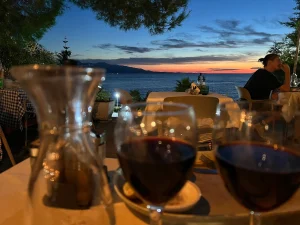
Near Mango Beach, Sarandë — Ionian Sea view.